Synthetic Turf Distributor Demand Strategy in 2026
Synthetic turf distributors have a unique view across products, installers, customers, applications, and geographic markets. In 2026, that position creates an opportunity to do more than supply existing demand - it can help distributors identify, test, and develop the markets that will drive future growth.
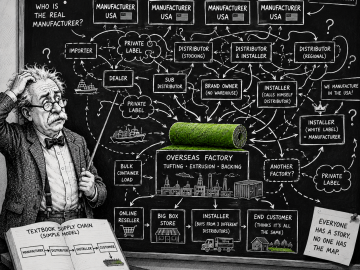
Synthetic turf distributors occupy an unusual position in the industry. Manufacturers know their products, installers know their projects and local customers, and property owners know the problems they are trying to solve. A distributor sits between all of them. It sees products moving through warehouses, installers growing or slowing down, applications gaining traction, customers asking for different specifications, quotes being won or lost, territories performing differently, and accounts changing their purchasing behavior.
That gives the distributor something an individual installer can never completely have: an aggregated view of the market.
Yet the traditional distribution model is largely designed to respond to demand after it already exists. A homeowner decides to install artificial grass. An installer wins the project. The installer needs turf. The distributor supplies it. The system can be extremely efficient, but by the time the distributor enters the transaction, most of the important demand-development work has already happened.
Someone introduced the customer to synthetic turf. Someone made the application familiar. Someone demonstrated that the product could solve the customer's problem. Someone created enough confidence for the customer to consider spending thousands of dollars replacing a lawn, building a putting green, resurfacing a playground, or creating a pet area.
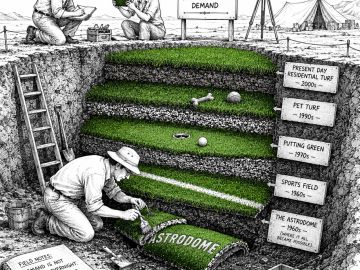
Today's synthetic turf industry inherited decades of that work. Research created viable products, major installations made them visible, manufacturers improved them, institutions legitimized them, contractors placed finished projects into communities, drought and water restrictions gave customers additional reasons to consider them, and years of advertising, search, referrals and word of mouth made artificial grass a recognizable category.
That accumulated demand is an asset, but it can also create a misleading impression that demand simply exists.
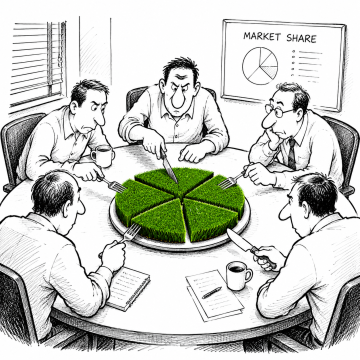
When an installer calls to order turf for a project already sold, the distributor is capturing demand. When a homeowner searches "artificial grass installer near me," several companies may compete intensely for that customer, but they are still competing for demand that has already formed. When distributors recruit the same established contractors and manufacturers pursue the same distributors, the industry can become increasingly efficient at redistributing existing demand without necessarily developing enough new demand.
Eventually, everybody is fighting over the same customer.
Advertising becomes more expensive. Search results become more competitive. Companies build pages for the same cities. Installers bid against one another. Distributors compete on price, availability and credit. Manufacturers compete for shelf space and dealer loyalty. The market may still be large, but increasingly sophisticated competition does not automatically make the market itself larger.
A demand strategy begins with a different question: where could demand develop next?
This is where the distributor's position becomes particularly interesting. One installer may know Los Angeles exceptionally well. Another understands pet turf. Another has discovered that putting greens are becoming unusually profitable. Another is suddenly losing residential lawn projects on price. Each sees a fragment.
The distributor can potentially see all of them.
One installer asking for a different product specification may be insignificant. Twenty installers asking similar questions may indicate a product opportunity. One account buying less could be a sales problem. Dozens of accounts declining across the same territory could indicate something happening in that market. Increased putting-green orders across several regions might suggest an application worth developing more deliberately. Repeated lost quotes may reveal pricing pressure. Accessory purchasing can reveal how projects are actually being built. Samples, customer questions, order frequency, complaints, substitutions and geographic sales patterns all contain information.
Most companies already collect much of this data. They simply collect it for operational reasons.
Orders exist so products can be shipped. CRM notes exist so salespeople remember conversations. Customer records exist for accounting. Product data exists for inventory. Photos sit in folders or social accounts. Installer relationships live partly inside individual employees' heads.
Seen independently, these are operational records. Seen together, they begin to describe a market.
Historical sales alone are not enough because sales primarily explain where demand has already been captured. The more valuable question is what internal activity, combined with external signals, says about where demand might be moving. Search behavior, demographics, construction, climate, water restrictions, competitor activity, local projects and customer questions can be combined with distributor data to identify opportunities before they become obvious in annual sales reports.
That does not require predicting the future perfectly. A distributor does not need to bet millions of dollars every time it sees a possible opportunity. This is one of the reasons market development in 2026 is fundamentally different from market development several decades ago.
Much of the first investment can now be digital.
A company can express Market Intent before committing major physical resources. It can define an application, publish useful information, organize relevant products, establish a position in a geographic market, educate potential buyers and installers, and begin observing whether the market responds.
Publishing a page does not magically create projects. Installers already publish pages for cities they barely serve, and companies routinely publish products they have barely begun selling. But that doesn't make the act meaningless. It makes it a relatively inexpensive market test.
You have to start somewhere.
Instead of waiting until a market is obvious enough for every competitor to see it, a distributor can place many small bets. Some will produce nothing. Some will generate searches, questions, sample requests, installer interest or transactions. Those signals justify greater investment.
Intent can then become Market Presence.
Now the distributor is no longer simply saying that it participates. Products are being purchased. Installers are active. Samples are circulating. Local campaigns may be running. Contractors are being trained. Projects are being completed. Customer questions are becoming more specific. The hypothesis is encountering the real market.
And real participation produces something digital publishing alone cannot manufacture indefinitely: evidence.
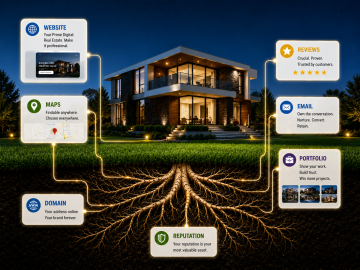
Every completed project creates potential photographs, video, technical knowledge, product-performance information, customer questions, reviews and local relationships. Over time, those assets can become Market Authority - not because the company has published the phrase "leading synthetic turf distributor" enough times, but because there is accumulating evidence connecting the company to actual products, applications, installers, projects and places.
That distinction is becoming more important as search and AI systems attempt to understand companies rather than simply match pages to keywords.
A photograph by itself says relatively little. A photograph connected to a documented project, installer, city, product, application and outcome says considerably more. The relationships between these digital objects can carry more information than the objects themselves.
This raises an interesting problem for an industry that has spent years publishing enormous amounts of material to Instagram, Facebook, TikTok and other platforms. A distributor or installer may have thousands of photographs showing legitimate work, yet many are captioned with little more than "another beautiful install." The evidence is real, but how much can search engines and AI systems reliably discover, interpret and associate with the correct company, market and application? And how much long-term authority has been left trapped inside platforms the business does not control?
In 2026, "post more on social media" is therefore a much less interesting strategy than asking how evidence created by the business becomes part of a durable digital entity that machines and customers can understand.
The same principle applies to the installer network.
Distributors often describe installers as customers or dealers. From a demand perspective, they are much more than that. They are distributed observation points across the market.
They talk to property owners. They see competitor products. They know which quotes customers reject. They discover unusual applications. They take photographs. They solve installation problems. They hear objections that may never reach the manufacturer. They know when customers suddenly become interested in putting greens, pet systems or a particular type of landscape conversion.
A distributor with hundreds of active installers therefore possesses a potential market-intelligence network that would be extraordinarily difficult for an individual company to build from scratch.
But only if information moves both ways.
The distributor can provide products, samples, education, referrals, market information, localized assets, incentives, co-op funding and other forms of market-development support. Installers can return project evidence, customer questions, competitive information, product feedback, lost-sale reasons and signals of emerging demand.
This is why defining distributor marketing as "giving installers leads" is far too narrow.
A lead is simply one output of a functioning demand system.
Channel incentives, market development funds, co-op programs and referrals are mechanisms through which distributors can help downstream partners participate in markets. Research from other industries has found measurable revenue and market-share improvements associated with channel incentive programs, while studies of market development funding have found higher-growth organizations investing more heavily in partner marketing. Those numbers should not be treated as promises of equivalent returns in synthetic turf, but they establish that channel development is an economically meaningful investment rather than a collection of promotional favors.
This may matter particularly for smaller installers. A large contractor can potentially fund its own website, advertising, content production, project documentation and local-market expansion. A small installer may depend much more heavily on the ecosystem around its suppliers.
That gives distributor investment leverage. One investment at the distributor level can potentially strengthen market participation across dozens or hundreds of independent companies. Withdrawal can work in the opposite direction. Less distributor support can mean weaker downstream marketing, fewer projects, fewer documented projects, less market evidence and eventually weaker signals flowing back to the distributor itself.
Customer information creates another feedback loop. A sales report can tell a distributor that an installer who once purchased $300,000 of turf now purchases $120,000. It cannot tell the distributor why.
Perhaps the installer is losing projects. Perhaps local demand has changed. Perhaps another distributor is cheaper. Perhaps customers want a different product. Perhaps the contractor has moved into another application. Perhaps the company itself is failing.
One conversation cannot answer a market question. Hundreds of consistently categorized conversations potentially can.
Customer recovery therefore becomes much more interesting when it stops being simply an attempt to persuade old customers to buy again and becomes a way of asking what is happening across the market. Lost customers, rejected quotes, product requests, pricing objections and sales conversations become inputs into demand intelligence.
The same information can influence product strategy. Repeated requests can reveal missing products. Installation problems can expose accessory opportunities. Regional differences can suggest different specifications. Customer objections can reveal where positioning or pricing no longer fits the market. Emerging applications may require products the current catalog was never designed to support.
Demand strategy and product strategy begin feeding each other.
AI makes all of this considerably more practical.
For years distributors have accumulated orders, CRM notes, emails, product specifications, PDFs, customer questions, photographs, quotes and sales histories that were too fragmented for anyone to analyze continuously. Much of that information became operational exhaust.
AI can increasingly classify it, connect it and expose patterns across it.
The advantage, however, is not simply having access to AI. Every competitor can buy access to similar models. The harder-to-copy asset is the proprietary history those models can reason across: years of customers, products, projects, questions, outcomes and market behavior.
A distributor that has organized that knowledge may therefore possess a substantial intelligence advantage over one starting from an empty prompt box.
All of this changes how market expansion should be viewed. The objective isn't necessarily to abandon established markets and chase speculative ones. Established markets pay the bills. But established demand also attracts established competition.
The earlier a distributor recognizes a new application, geography or customer segment, the more time it has to develop knowledge, relationships, projects and authority before the opportunity becomes obvious to everyone else.
Some experiments will fail. That is precisely why the earliest stage should be inexpensive.
Establish Market Intent. Watch what happens. Invest where the evidence strengthens. Build Market Presence through real participation. Capture what that participation produces. Turn it into Market Authority. Use the resulting data to decide where to go next.
The process compounds.
Projects create evidence. Evidence improves visibility and credibility. Visibility produces inquiries. Inquiries produce customers. Customers produce more projects. Every cycle can make the next cycle easier.
But the opposite can compound too.
A mature company can reduce demand investment and continue receiving business for quite some time. Customers still know the brand. Old pages still rank. Installers still call. Projects remain visible. Referrals continue. Years of accumulated market presence do not disappear on the day an advertising campaign stops.
That can create another dangerous assumption: if sales continue after investment stops, perhaps the investment was unnecessary.
What the company may actually be doing is harvesting market equity accumulated over previous years without replenishing it.
Eventually fewer new assets are created. Visibility weakens. Competitors occupy positions that were left unattended. Installer relationships change. Search presence decays. Customer awareness fades. The effect is delayed, which makes the cause easy to underestimate.
Demand therefore should not be treated as a faucet that can simply be turned on again when sales become uncomfortable.
It is closer to demand infrastructure.
For the synthetic turf distributor, that infrastructure should connect market intelligence, digital presence, installer participation, customer feedback, product knowledge and the evidence generated by actual projects. It should continuously observe what is happening, test where opportunities might exist, increase investment where the market responds, enable partners to participate and capture what the resulting activity teaches the business.
Manufacturers still have a role. Installers still create demand. Architects, municipalities, media, consumers, regulation and countless other forces still shape the market. No distributor controls synthetic turf demand.
But distributors occupy one of the few positions in the industry where signals from all of those activities can converge.
That is their advantage.
The synthetic turf distributor of 2026 does not need to know with certainty where the next market will emerge. It needs the ability to recognize possible markets earlier, test them more cheaply, learn from a larger network and invest faster when evidence begins to appear.
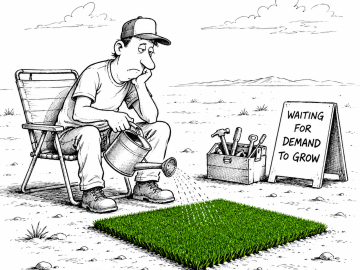
Otherwise the strategy is ultimately to wait until someone else creates the demand - and then compete for a share of it.
Explore the Demand System
The strongest installation businesses are built by understanding more than where the next lead comes from. Explore how synthetic turf demand develops, how markets are created, how digital authority accumulates, and how the infrastructure behind your business can turn today's projects into future demand.