Synthetic Turf Installer Demand Strategy for 2026
Synthetic turf installers operate in a growing industry, but growth alone does not guarantee a stronger business. In 2026, installer demand strategy means choosing the right markets, building authority from every project, protecting the assets you create, and deciding what kind of business you ultimately want to own.
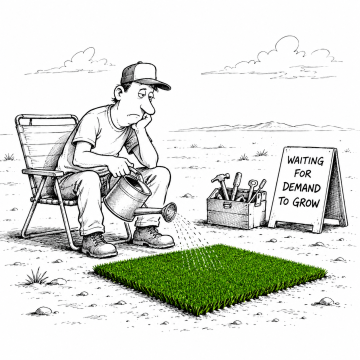
The synthetic turf industry is still growing. That sounds like good news for anyone considering starting an installation company, expanding an existing one, or simply wondering whether there is still money to be made installing artificial grass.
It probably is good news.
But industry growth and installer opportunity are not quite the same thing.
A market can grow while individual companies inside it struggle. It can grow while prices become more competitive, advertising becomes more expensive, established installers become harder to displace, and distributors fight harder for the contractors already buying turf. It can even grow while a particular installer steadily loses revenue.
This matters because one of the easiest mistakes in business is to look at a growing industry and assume that growth is somehow waiting to be collected.
It isn't. Someone already owns parts of it.
If you are thinking about opening a synthetic turf installation business in a city today, the first question probably shouldn't be whether people there buy artificial grass. Obviously that matters. But you also need to know who already participates in that market, how long they have been there, which applications they are known for, which distributors supply the territory, which manufacturers have established dealer relationships, how strong the existing installers are, and how much evidence already exists connecting those businesses to that market.
A city with substantial synthetic turf demand may be a terrible place to enter if ten established companies are fighting aggressively over it.
A market with less obvious demand may be considerably more interesting if the conditions for turf are good and nobody has developed a particularly strong position yet. Which immediately creates another problem: what exactly does it mean to enter a market?
For an installer, it used to mean something fairly physical. You had a crew, equipment, a truck, access to turf, and some reasonable distance you were willing to drive.
Those things still matter because artificial grass stubbornly refuses to install itself through the internet.
But the market begins long before the truck arrives.
Customers discover applications digitally. They search for solutions. They look at projects. They read reviews. They compare installers. They encounter putting greens they hadn't considered building. They see somebody else's backyard conversion. They ask AI systems questions. They watch videos. They learn terminology. They decide what looks expensive, cheap, difficult, desirable or trustworthy.
So an installer can begin developing a market before it has developed substantial physical presence there. That is Market Intent.
It is not particularly difficult to publish intent. Any installer can create a page saying it serves Miami tomorrow morning. It doesn't mean Miami will suddenly start sending projects. But there is an important difference between saying we might like to work there and making a $200,000 operational commitment to a market that hasn't demonstrated that it wants you.
Digital market development gives an installer room between those two decisions. You can establish intent, watch what happens, learn, and invest further when the evidence becomes stronger. Eventually intent has to collide with reality.
Someone has to call. Someone has to request a quote. A project has to be won. The crew has to drive there. Turf has to go into the ground. Customers have to be satisfied. Now there is Market Presence.
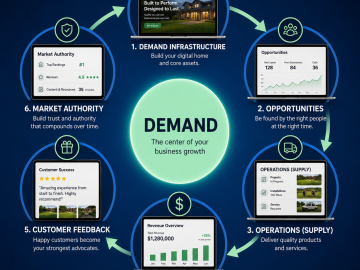
And if enough of those projects accumulate, something else starts happening. People recognize the company. Reviews accumulate. Search engines encounter repeated evidence. Project photographs show up in different places. Builders, landscapers or pool contractors know who to call. A distributor knows that this installer moves product in the area. Previous customers refer new customers. The company knows how projects behave locally because it has actually done them. That begins to look like Market Authority.
This is where two installation businesses that appear almost identical from the road can become completely different businesses economically. Both might have three crews. Both might install 25 projects a month. Both might purchase similar turf from the same distributor. But one completes the installation, collects payment, posts three pictures to Instagram and goes looking for the next job. The other has just manufactured assets.
The project has a location. It has an application. It used a particular product. It solved a particular customer problem. It produced photographs and video. There were technical decisions. There may be a review. There were questions the customer asked before buying. There may have been alternatives the customer considered. There is now another piece of evidence that this company actually performs this kind of work in this market.
The first company earned revenue. The second company earned revenue and increased the probability of earning future revenue.
This is essentially the difference between doing jobs and building a business out of jobs.
It is also why the number of projects an installer has completed is such an incomplete measure of what it has built.
Imagine a company installing 25 projects a month for ten years. That is 3,000 projects. What remains?
If the answer is mostly invoices and some photographs scattered across phones, Instagram accounts and old folders, an extraordinary amount of business value has disappeared.
Those 3,000 projects could represent thousands of geographic signals, customer problems, installation conditions, product experiences, reviews, photographs, videos, case studies, referral relationships and examples of actual market demand.
The physical turf is sitting in somebody's yard. The knowledge generated while putting it there belongs to the installer - assuming the installer bothered to keep it.
And installers have access to a kind of knowledge that manufacturers and distributors cannot completely reproduce, because installers stand closest to the customer.
The manufacturer knows what it manufactured.
The distributor knows what was purchased.
The installer knows why somebody wanted it.
A customer rarely wakes up passionately wanting 1,200 square feet of 80-ounce polyethylene turf.
They want the dog to stop turning the yard into mud. They are tired of trying to grow grass under trees. They want somewhere to practice putting. They don't want children running through dirt at a daycare. They are tired of maintaining an awkward strip beside the pool. They have a rooftop nobody uses. They have a landscaping problem. Some of those problems already have well-developed synthetic turf markets around them. Others may not.
That puts installers in an interesting position. They don't merely participate in existing markets. Because they hear customer problems directly, they can potentially recognize new markets while those markets are still forming.
One strange request means nothing. The same strange request twenty times is information. And this is where an installer can make exactly the same mistake with customer conversations that it makes with project photographs: use them once and throw them away.
A lost quote is disappointing. Fifty lost quotes categorized by reason are market intelligence.
A customer asking for something you don't offer is inconvenient. Fifty customers asking for it may be a business opportunity.
The question stops being only how many leads did we get?
It becomes what are those leads teaching us about the market?
That can lead to expansion, but expansion itself is more complicated than drawing a larger circle around the office. Suppose a successful residential lawn installer wants to grow.
It could enter the next city. Or it could stay exactly where it is and develop pet turf. Or putting greens. Or playgrounds. Or commercial properties. Or relationships with pool contractors. Those are all new markets. Geography is only one dimension of market expansion.
Sometimes moving into another application where the company already has crews, reputation and local relationships may be considerably easier than attempting to recreate its existing business 150 miles away. Sometimes the opposite will be true.
And eventually a successful installer runs into another interesting question: how local does an installation company actually need to be?
The installation itself is local. The demand system doesn't necessarily have to be.
A company capable of generating customers in multiple states could theoretically fulfill that demand through regional crews, subcontractors or installer partners. At that point, it begins changing character. It may still sell installations to the end customer, but economically it starts behaving partly like a demand aggregator.
Continue far enough and the distinction between installer, installation network, franchise and distributor begins getting surprisingly blurry. Which brings us backward to a decision that many installers make much earlier: whether to build independently at all.
A franchise offers an appealing proposition precisely because building markets is difficult. You are not simply paying for a logo. Ideally, you are purchasing a system that already contains some combination of recognition, positioning, processes, training, product relationships, marketing infrastructure, technology, reputation, territory and accumulated knowledge. That can be extremely valuable. The interesting comparison isn't franchise versus free. An independent business isn't free.
If a franchise requires an initial fee, ongoing royalties, marketing contributions and required systems, the independent installer should be spending money too - assuming it intends to build anything substantial. The better comparison is therefore between the cost of participating in someone else's established market system and the cost of developing your own.
What could an independent installer build with the equivalent of five years of franchise fees, royalties and marketing contributions?
Over those same five years, an independent installer could put comparable capital into its own brand, website, advertising history, local visibility, customer database, project library, reputation, partnerships and operating systems.
Perhaps the franchise produces a far better return. Perhaps it allows the owner to reach profitability years earlier and avoid expensive mistakes. Or perhaps the independent investment ultimately produces a more valuable asset. The answer depends on the particular franchise, operator and market. But there is another number worth putting beside the financial return:
What do you own after five years?
Who owns the domain?
Who owns the customer relationships?
Who owns the photographs?
Who owns the advertising accounts?
Who owns the reviews?
Who owns the local reputation?
Who owns the data?
Who owns the brand people have learned to search for?
And what happens to those assets if the relationship ends?
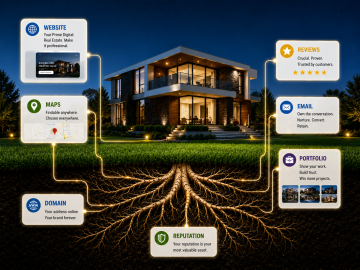
Those questions matter because a turf installation business can spend years creating market equity without necessarily owning all of the infrastructure in which that equity accumulated. Independence creates its own dependencies, of course. One of the largest is supply.
A new installer may depend almost completely on a local distributor. That can be rational. The distributor holds inventory, provides samples, extends credit, handles logistics, knows the products, supports warranties and eliminates the need for the installer to tie up enormous amounts of cash in rolls of turf. But as the installer grows, the economics change.
One supplier can become several. Distributor relationships can become manufacturer relationships. Larger volume can make direct purchasing conceivable. Eventually private-label products may become practical. And once an installation company controls enough demand, supplying that demand becomes interesting in its own right.
The installer can slowly begin becoming a distributor.
This isn't necessarily the correct destination. Warehouses, inventory and logistics create an entirely new collection of headaches. A cheaper cost per square foot can become extremely expensive after freight, cash requirements, dead inventory and quality problems are included. But the possibility illustrates something important about installer strategy.
The business model is not fixed. A person who begins with a truck and installation experience does not have to own the same kind of company ten years later.
The company might remain a highly profitable local specialist. It might become a regional installation company. It might specialize in putting greens and build authority far beyond its original territory. It might develop private-label products. It might build a network of installation partners. It might franchise its system. It might become a distributor.
What determines the sensible path is not simply how many jobs are available next month. It is what assets and advantages the company has been accumulating while doing those jobs. This is also why specialization deserves more thought than it usually receives.
"We install artificial grass" sounds like a larger market than "we build residential putting greens." And technically it is. But the larger market also contains everyone.
Specialization can produce deeper expertise, stronger evidence, more relevant referrals, better processes and potentially greater pricing power. A company does not necessarily need to own the largest possible market. It needs a sufficiently valuable market in which it can build a defensible position. The same logic applies to B2B relationships.
A homeowner may buy one turf installation in a decade. A pool contractor may encounter suitable projects every month. A landscaper may repeatedly encounter customers asking about low-maintenance lawns. A property manager can control multiple properties. A builder can produce an entire development. A veterinarian or pet facility can introduce a specialized problem. An architect can influence projects before an installer is ever contacted. The installer who buys every customer individually through advertising is building a different demand system from the installer who becomes embedded in relationships that repeatedly produce opportunities. Again, both can work. But one completed job is not necessarily equivalent to another in what it can create afterward.
Even the customer who already bought something may have more economic life than the industry traditionally assumes. Synthetic turf is generally treated as a one-time installation transaction, yet projects eventually require cleaning, repairs, infill work, seam attention, odor treatment, brushing, putting-green adjustment or other maintenance. Commercial installations in particular may create opportunities for ongoing service.
Whether recurring service can become meaningful enough to matter economically is something worth examining rather than assuming. But it points toward the same broader idea: installers routinely spend significant money acquiring relationships and then stop thinking about those relationships when the installation is complete. The internet has made that waste easier to see because so much of the accumulated value can now persist.
A project can keep producing demand years after the crew leaves. A useful case study can be discovered repeatedly. A review can influence hundreds of customers. A properly documented solution can answer questions for people the installer has never met. A strong local position can lower the cost of acquiring the next customer. And now AI adds another layer.
For years, turf companies could publish a website, maintain a Google Business Profile, collect reviews and post project photos with a fairly understandable objective: appear where customers search. Discovery is becoming less linear.
A customer can now ask an AI system which turf companies operate in an area, who specializes in putting greens, whether artificial turf makes sense for dogs, what products are appropriate, what problems to watch for, and potentially which companies appear credible. Nobody outside these systems knows a neat formula assigning five points for a review and three points for an Instagram photograph. That is probably the wrong way to think about it anyway. The more durable objective is to create enough consistent, connected evidence that the business becomes difficult to misunderstand.
The company says it installs putting greens. Its projects demonstrate putting greens. Customers review putting-green projects. Its distributor or manufacturer associates it with relevant products. Its photographs show the work. Its website explains the work. Its geographic evidence demonstrates where it has actually worked. Other sources corroborate that the company exists and does what it claims. That is much harder to fake than publishing another page saying Best Artificial Grass Installer in Jacksonville, Florida.
It is also why years of random social publishing deserve another look. Thousands of legitimate turf projects may already exist on Instagram, TikTok and Facebook. Whether those platforms transfer much authority to the underlying business, how reliably AI systems can consume the posts, and how much evidence remains trapped inside third-party platforms are increasingly important questions.
The photographs themselves are valuable. The question is whether the business has built anything durable from them. And perhaps that is the simplest way to think about installer demand strategy in 2026.
The industry may continue growing. More customers may adopt synthetic turf. New applications may emerge. AI may change how companies are discovered. Manufacturers may introduce better products. Distributors may develop stronger installer programs. None of those things guarantees that a particular installer becomes stronger.
A company becomes stronger when today's work improves its position tomorrow.
The installer who finishes a project and begins again from zero needs another job.
The installer who finishes a project and gains a review, project evidence, customer knowledge, local relevance, a referral relationship and a clearer understanding of the market has done something different.
It has converted operations into assets. Enough of those assets create Presence. Enough real Presence, accumulated and connected over time, creates Authority. And Authority changes the economics of future demand.
So perhaps the most important question for a synthetic turf installer in 2026 isn't whether the industry is growing, whether Google Ads still work, whether joining a franchise is better than remaining independent, whether another city should be added, or whether buying directly from a manufacturer can save twenty cents per square foot. All of those questions matter. But they come after a more fundamental one:
What are you trying to own five years from now?
If the answer is simply more completed installations, the business may become larger. If the answer includes a market, a reputation, customer relationships, proprietary knowledge, project evidence, digital assets, supplier leverage and a demand system that becomes stronger with every installation, the same five years of work can build something very different.
The turf eventually belongs to the customer.
What the installation leaves behind should belong to the business.
Explore the Demand System
Understand the larger system behind installer growth — how synthetic turf demand develops, how markets are created, and how digital infrastructure, market presence, and authority work together to support future demand.
Related Synthetic Turf Industry Insights
Explore broader industry analysis on synthetic turf business models, market opportunities, competition, digital strategy, and the forces changing how turf companies grow.