Why Many Landscapers Struggle to Grow Into Synthetic Turf
August 4, 2026
Many landscapers assume synthetic turf is simply another service to add alongside mowing, irrigation, or landscape design. The installation techniques may be different, but the real challenge isn't learning how to install turf - it's learning how to sell it. Businesses built around recurring $50 lawn visits often rely on referrals, scheduling platforms, or third-party lead sources. A synthetic turf company, however, competes for projects worth $10,000 or more, where homeowners spend weeks researching contractors before making a decision. Understanding that shift may be the single biggest difference between adding synthetic turf as a service and building a successful synthetic turf business.
Quick Navigation
You're Not Just Changing Services
Many landscapers think moving into synthetic turf means learning a new installation technique.
In reality, they're changing business models.
The math makes this obvious once you line it up. A lawn mowing visit typically runs $42 - $90, with most homeowners spending around $50 - $150 per visit and a national average closer to $50 - $205 depending on lot size. A landscaper can reasonably complete a dozen or more of those in a day.
A synthetic turf installation is a different animal entirely. The average residential project runs somewhere in the $5,800 - $7,400 range nationally, with most homeowners paying between $2,725 and $15,000 depending on square footage, and larger or premium jobs regularly clearing $10,000 - $20,000. Pricing runs roughly $10 - $20 per square foot installed, and a single 1,000 - 2,000 sq. ft. yard can land a $12,000 - $19,000 invoice. That's not a bigger job. It's a different sale - closer to a kitchen remodel than a mowing route.
A lawn mowing company might complete twenty $75 jobs in a week. A synthetic turf installer may complete one $12,000 project in that same week.
The way customers find those two businesses is completely different - and that's the part almost nobody talks about.
The U.S. landscaping services industry itself is worth about $188.8 billion in 2025, growing roughly 5 - 6% a year, spread across nearly 700,000 mostly small businesses where no single company holds more than about 5% market share. The synthetic turf market is smaller but growing faster - the global market is valued at roughly $5.3 - $7.3 billion depending on the estimate, with the U.S. residential/landscape segment alone projected to grow from about $1.1 billion to $1.6 billion by 2030, a CAGR north of 6%. It's a real, expanding opportunity. But the businesses that succeed in it aren't the ones who simply bolt turf onto their existing lawn-care demand engine. They're the ones who understand that engine doesn't generate $12,000 leads.
The Jobber Mindset
This is the phrase that ties everything together.
For many lawn care companies, demand comes from somewhere else.
Jobber. Yardbook. Angi. Google Local Services. Facebook groups. OfferUp. Neighborhood recommendations.
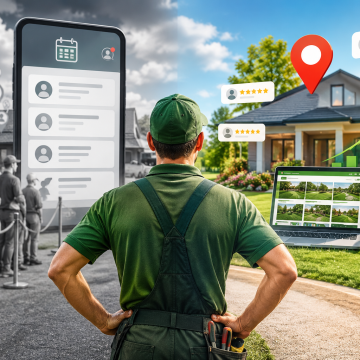
The company simply waits for work to appear. The software becomes part of its demand infrastructure. The landscaper focuses on operations.
That's not a criticism - for a $50 - $150 mowing job, it's a rational way to run a business. The problem is that the mindset travels with the landscaper into every new service line they add, including one where it no longer works.
Jobber Isn't Just Scheduling Software
People think Jobber is software for estimates and invoices.
In reality, Jobber has invested heavily in becoming part of how customers discover local service providers - and in teaching contractors how to be found. Its Academy publishes detailed marketing guides covering local SEO, content marketing, Google Business Profile optimization, reviews, and lead generation. It runs a free "Get Noticed Score" local SEO audit tool. It publishes guidance on building a landscaping website, running paid ads, and layering social media, direct mail, and referral programs into a single acquisition strategy. It even builds contractor websites directly.
That's demand infrastructure. Jobber isn't just helping landscapers manage the work that shows up. It's shaping where and how that work begins to exist in the first place - and it has built an entire content and product ecosystem to keep contractors inside that system.
The Business Changes at $10,000
That model works reasonably well when your average invoice is $75. Or $150. Even $500.
But when every project is worth $10,000 - $20,000, the math changes completely. You don't need twenty leads a week - you need two or three good ones a month. But each one has to convert, because a lost $12,000 sale isn't a rounding error the way a missed $75 mow is. And the customer making that decision isn't behaving like someone booking a recurring mow. They're researching, comparing quotes, reading reviews, and looking at project photos the way they would for a kitchen or a roof.
Can you really expect someone else to supply enough qualified customers for a business built on $10,000+ tickets? For most installers, the honest answer is no - and yet many keep operating as if the answer is yes.
The Jobber Mindset Doesn't Stay Behind
Many new synthetic turf installers leave landscaping, or add turf as a new division, but they bring the same mindset with them.
Instead of relying on Jobber, they expect manufacturers or distributors to generate demand.
The conversations sound familiar. We'll send you leads. Become a dealer. Buy more product. Reach the next pricing tier.
These aren't invented phrases - they're close to verbatim from how the industry actually markets itself to new installers. Dealer program pages promise "a steady stream of quality leads," "lead generation," "leads generated within your coverage area," and marketing collateral built and paid for by the manufacturer. Some frame it as a full business-in-a-box: product, training, branding, and lead flow, in exchange for buying inventory and, in some cases, an exclusive territory.
The expectation is still the same as it was under the Jobber mindset. Someone else will fill the pipeline.
The Circular Problem Nobody Talks About
This is the part almost nobody says out loud.
Manufacturers hope local installers will invest in marketing. Local installers hope manufacturers will generate leads. Distributors hope installers will build strong local brands. Installers hope distributors will advertise nationally.
Everyone is waiting for someone else to create demand.
And here's the tell: the manufacturers themselves don't actually believe their own lead-generation promise is sufficient - because many of them turn around and teach their dealers how to do local SEO. SYNLawn's distributor program, for example, offers "Kickstarter" websites for an immediate online presence, plus ongoing guidance in SEO and PPC, social media support, and CRM and lead-tracking training. That's a manufacturer explicitly coaching its own dealers on how to generate their own local demand - which only makes sense if the manufacturer's lead flow isn't enough on its own.
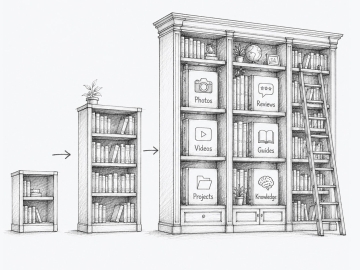
Meanwhile, the companies investing in their own websites, local SEO, reviews, project galleries, educational content, AI search visibility, and digital assets quietly become the market leaders in their city - regardless of which manufacturer's logo is on their truck.
Manufacturers Generate Demand - Just Not Enough for Everyone
To be fair to manufacturers and distributors, many of them are genuinely active in demand generation. Larger turf brands run national advertising campaigns, maintain retail partnerships (SYNLawn's presence in Lowe's, for instance), publish product and installation content, and push leads down through dealer networks. Distributors like Turf Distributors, Turfscape, and Synthetic Turf International all publicize dealer training programs and marketing support as core parts of their pitch.
The issue isn't that this content and lead flow don't exist. It's that they're diffuse by design. A manufacturer's national campaign has to serve every dealer in every territory at once - it can't optimize for "the guy three miles from this specific homeowner's house." A distributor's shared leads get split across every dealer competing for the same territory. None of it substitutes for a business having its own reviews, its own local rankings, its own project gallery, and its own reputation in its own city. That has to be built locally, by the installer, or it doesn't get built at all.
Learn how to choose the right synthetic turf distributor or manufacturer that can help generate leads, provide ongoing support, and grow your business.
Who Owns the Demand Infrastructure?
The pattern shows up everywhere in home services, not just landscaping and turf. SiteOne Landscape Supply - the largest landscape products distributor in the U.S., with roughly four times the market share of its next competitor - explicitly models itself on Home Depot's playbook: content marketing, SEO-targeted informational content, e-commerce, and paid media, all built to be the first stop in a customer's or contractor's search. Home Depot, Angi, and Jobber all operate the same way: they publish buying guides, cost calculators, how-to content, and local landing pages precisely because owning that discovery layer is where the leverage sits.
None of these companies are hiding what they're doing. They're telling you, in public content, exactly how demand gets created in a home-services market - and then selling access to a version of it. The independent installers and landscapers who study that playbook and build their own version of it locally - their own SEO, their own reviews, their own galleries, their own educational content - end up owning something the leads-included dealer arrangement never gives them: a customer relationship and a search ranking that belongs to them, not to whoever supplied the product that month.