
Digital Entity Foundation
A Digital Entity Foundation is the organized system that connects your digital assets, operational knowledge, and business data into a single source of truth - enabling your company to consistently publish, manage, and scale its market presence over time.
It provides the structured architecture required to publish and manage your business presence seamlessly across websites, customer portals, AI search systems, and enterprise platforms. Whether organizing assets for a single website or connecting multiple companies, regional markets, and ERP systems, a strong foundation ensures your business can scale efficiently while maintaining ownership, consistency, and long-term enterprise value.
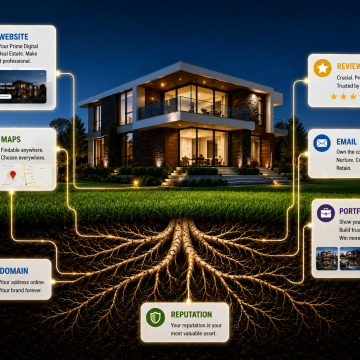
Organize Your Business Before You Publish It
Every day, your business generates valuable assets: project photos, customer reviews, technical documentation, product data, and operational knowledge.
You already own this information - but without structure, it remains scattered across phones, cloud folders, inboxes, and third-party tools. As your organization grows, finding, updating, and reusing these assets becomes increasingly difficult and inefficient.
Building a Digital Entity Foundation turns that fragmented data into an organized, owned asset. It creates a centralized engine that makes it effortless to publish, reuse, and scale your business information across every digital touchpoint.
Every Business Creates Digital Assets
The question is whether your team can quickly find, manage, and reuse them. Imagine a salesperson needs photos of bocce court installations during a customer meeting, a web designer needs playground project images for a new page, or a marketer wants customer reviews for an email campaign. Can they find exactly what they need in seconds, or do they spend hours of paid time searching across phones, email, cloud storage, and shared folders?
A small business may store information in:
- Google Drive
- Dropbox
- Windows or Mac folders
- Project photos on employee phones
- Customer reviews on Google
- A single website
- Email attachments
- PDFs and documents
Larger organizations often manage information across many connected systems, including:
- Multiple websites
- Multiple brands or companies
- Regional and local market websites
- CRM systems
- ERP platforms
- Product Information Management (PIM)
- Digital Asset Management (DAM)
- Business Intelligence dashboards
- APIs
- Customer portals
- Internal databases
- AI knowledge systems
Regardless of size, every business depends on organizing the same underlying business information.
Organizing business information is no longer just an IT responsibility - it's a business capability. Like inventory, equipment, or customer relationships, your digital assets require structure, ownership, and ongoing management. A strong Digital Entity Foundation ensures your business knowledge is organized, accessible, and ready to support sales, marketing, customer service, and future growth.
What Information Forms Your Digital Entity Foundation?
A Digital Entity Foundation is built from three core information layers: business assets, business knowledge, and structured business data. Together, they create the organized source of truth that powers your websites, AI visibility, customer portals, market expansion, and future digital initiatives.
Core Business Assets
- Business identity
- Project library
- Photo library
- Video library
- Case studies
- Customer reviews
- Product catalog
- Service catalog
- Documents
- PDFs
- Certifications
- Technical specifications
Business Knowledge
- FAQs
- Installation knowledge
- Technical knowledge
- Best practices
- Internal documentation
- Training materials
Business Data
- Customers
- Products
- Locations
- Markets
- Employees
- Suppliers
- Inventory
- Pricing
- Categories
- Relationships between data
The foundation is not defined by where information is stored - it is defined by how well that information is organized, connected, and owned.
Built to Scale with Your Business
The same principles apply whether you operate one website or hundreds.
Small Businesses
A Digital Entity Foundation helps organize everyday business assets so they are easy to find, publish, and reuse.
Typical examples include:
- One company
- One website
- Project library
- Reviews
- Photos
- Videos
- Product documents
- Google Business Profile
Growing Businesses
As businesses expand, additional systems become part of the same foundation.
Examples include:
- Multiple websites
- Multiple office locations
- Regional market pages
- Multiple brands
- Customer portals
- Product databases
- CRM integration
- Marketing automation
Enterprise Organizations
Large organizations often connect business information across many systems while maintaining a single source of truth.
A Digital Entity Foundation may include:
- Multiple companies
- Enterprise websites
- Country-specific websites
- Location-specific websites
- ERP integration (NetSuite, SAP, Microsoft Dynamics)
- CRM platforms
- Digital Asset Management
- Product Information Management
- Business Intelligence dashboards
- API integrations
- Internal knowledge systems
- AI publishing pipelines
The architecture becomes more sophisticated, but the goal remains the same: organize business information once and publish it everywhere it creates value.
Why the Foundation Matters
Most businesses invest in websites.
The strongest businesses invest in the information behind those websites.
A website can be redesigned.
Marketing campaigns eventually end.
Search algorithms change.
But a well-organized Digital Entity Foundation continues growing alongside your business, making every future website, marketing campaign, AI platform, customer portal, and digital initiative faster, more consistent, and more valuable.
Your Foundation Determines Your Growth Potential
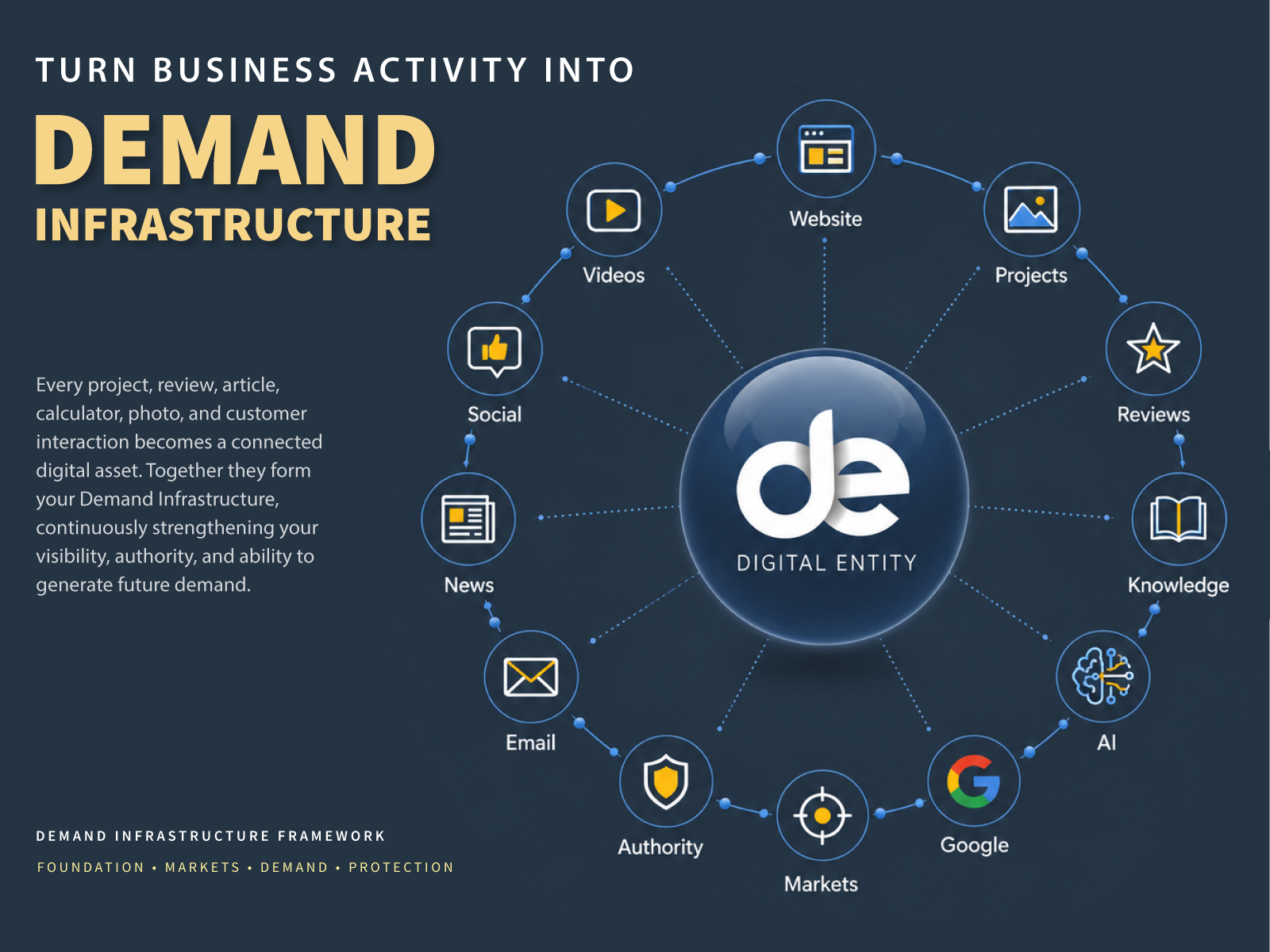
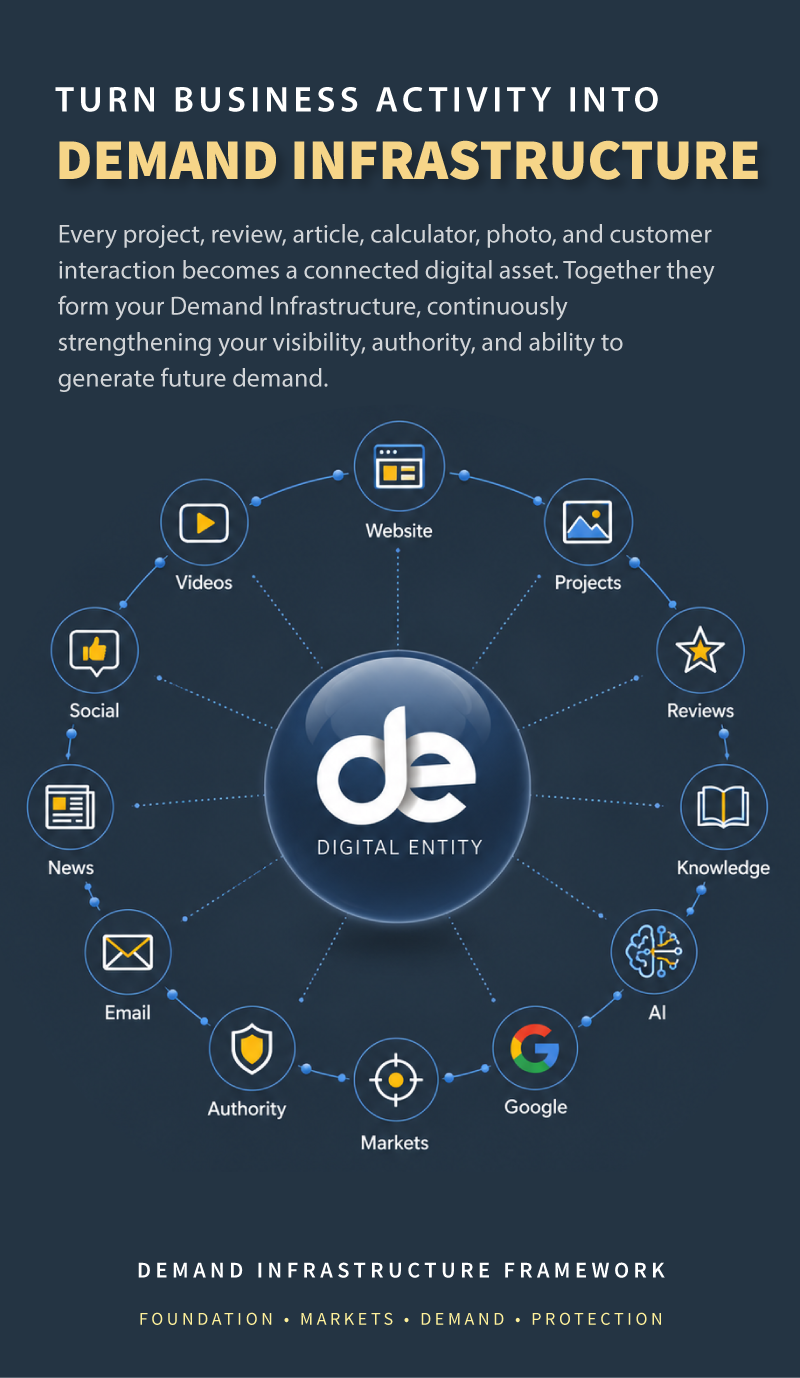
Demand Infrastructure can only grow as effectively as the foundation that supports it.
The better your business information, knowledge, data, and digital assets are organized and connected, the easier it becomes to publish new information, enter new markets, support AI discovery, launch additional websites, integrate business systems, and continuously strengthen your Digital Entity.
Over time, those connections form something more valuable than a collection of pages: a business graph.
Projects connect to services. Services connect to markets. Products connect to applications. Reviews connect to customers and completed work. Images connect to projects and locations. Business data connects current activity with the history the company has accumulated over years.
A competitor can reproduce the visible interface. It can study the navigation, copy the page types, and build an equivalent geographic footprint.
What it cannot reproduce is the accumulated business history behind them - or the system that turned that history into a connected business graph.
A Digital Entity Foundation is therefore not simply a technology investment. It is the long-term organizational foundation that allows a business to preserve what it learns, compound the value of what it produces, and expand its digital presence without continually starting over.
Ready for AI Search and Future Platforms
For years, digital growth could often be approached as a publishing problem: build more pages, target more keywords, and produce more content.
In the AI era, more content alone is no longer much of an advantage. Content can now be produced cheaply, quickly, and at enormous scale by almost anyone.
The harder advantage to reproduce is the business itself: its projects, products, markets, expertise, relationships, history, customer evidence, and ongoing activity - and how clearly those facts are connected.
That is the value of the business graph.
Search engines, AI systems, and future discovery platforms increasingly need to understand not only what a business says, but what the business is, what it does, where it operates, what evidence supports those claims, and how those facts relate to one another.
And that graph cannot remain static.
New projects are completed. Products change. Markets develop. Reviews accumulate. Employees and partners change. New expertise is created. Old information becomes obsolete.
A strong Digital Entity Foundation provides the structure for continuously adding, connecting, distributing, and updating that business knowledge.
The competitive advantage is no longer simply having more pages.
It is having a richer, better-connected, and fresher representation of the real business behind them.
How Much of Your Business Are You Losing Every Day?
Every Day You Wait, Your Business Creates More Unorganized Assets.
Scattered data isn't just messy, it's lost demand. Every day it stays disorganized, you're bleeding customers you already earned.
Stop rebuilding from scratch every marketing cycle. Contact us today and start building Demand Infrastructure that compounds with your business, not against it.
Build Your Digital Foundation Around the Markets You Serve
Your Digital Entity Foundation organizes the business information, knowledge, projects, and digital assets that support each market you serve. Explore residential, commercial, and public synthetic turf markets to see how the same foundation can support different customers, project types, and growth opportunities.



Digital & Business Solutions for Synthetic Turf Businesses
Extend your Digital Entity Foundation into the systems that support growth. Explore solutions that help turn organized business information and digital assets into stronger markets, more efficient operations, and a more effective digital presence.