Does It Make Sense to Start a Synthetic Turf Business in 2026?
August 4, 2026
Every distributor's website will tell you 2026 is "the best time ever" to get into synthetic turf. That's their pitch, and it's not entirely wrong - the market really is growing. But growing markets don't automatically mean profitable installers. What actually decides whether you make money isn't the product spec sheet. It's the parts nobody puts in the brochure: licensing, labor, warranty exposure, and who's actually going to hand you customers once you've spent your savings on a trailer and a stack of turf rolls.
This article is written from the installer's side of the table, not the distributor's.
Quick Navigation
Yes, the Market Is Growing - But the Numbers Are All Over the Place
If you Google "synthetic turf market size 2026," you'll get a different number from every research firm - and that's worth noticing before you build a business plan around any single one of them.
- Grand View Research puts the global artificial turf market at roughly $7.8 billion in 2026, growing to $13.7 billion by 2033 - a CAGR of about 8.3%.
- Mordor Intelligence estimates it slightly higher, around $7.3 billion in 2026, growing at roughly 12.5% CAGR through 2031, and specifically calls out that landscape applications are growing faster (about 14.6% CAGR) than sports turf, driven by drought and water-restriction laws.
- Other firms report numbers as low as $4 billion or as high as $150 billion depending on how broadly they define "market" (raw material vs. finished installs vs. adjacent categories).
The honest takeaway: don't trust the single flashy stat a distributor puts in bold on their homepage - check whether it's measuring the same thing you're trying to sell. What's consistent across nearly every report is the driver: water-conservation laws. California's AB 1572 and Colorado's SB 24-005 both restrict or ban new nonfunctional turf irrigation, which is pulling residential landscaping demand forward regardless of which market report you trust. That's real, local, and it's the trend actually worth building a business around - not the global billion-dollar headline number.
Registration and State Licensing - Don't Skip This
Turf installation isn't federally regulated, but most states treat it as landscaping or general contracting work, which means:
- Business registration. LLC or sole proprietorship, registered with your state - the same as any small business.
- Contractor's license. Many states require a landscaping or general contractor license once your job size crosses a dollar threshold (this varies enormously - some states have no threshold, others exempt work under $500 - $1,000). Check your state contractor licensing board directly; don't rely on a distributor's blanket "no license needed" claim, because that's often true only for their state, not yours.
- Liability insurance. General liability is close to non-negotiable - most municipalities, HOAs, and commercial clients will require a certificate of insurance before you're allowed on site.
- Local permits. Some municipalities require permits for grading, drainage changes, or base excavation, especially for larger commercial or sports-field jobs.
The point most "how to start a turf business" articles bury: licensing requirements are set by your state and county, not by your distributor. A distributor telling you "you don't need a license to install our product" may be legally accurate in their home state and legally wrong in yours. Verify locally before you sign anything.
Equipment and Crew You Actually Need to Start
You don't need a warehouse to start. A lean residential-focused startup typically needs:
Equipment
- Sod cutter or turf/vegetation removal tools
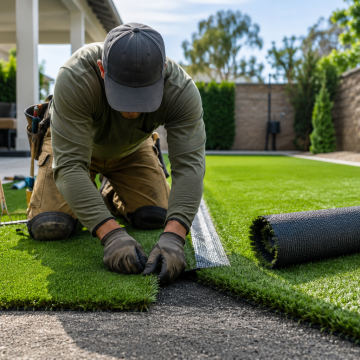
- Plate compactor (for base compaction - this is the single most important step for a turf install that doesn't fail)
- Landscape rake, hand tamper
- Utility trailer or box truck for material and equipment transport
- Power broom (for infill and fiber grooming)
- Seaming tools, turf knives, turf staples/nails, seam tape and adhesive
- Basic hand tools: wheelbarrows, shovels, levels
Crew
- A 2 - 3 person crew can realistically handle most residential jobs (500 - 2,000 sq ft) in 1 - 2 days.
- One experienced lead who understands base prep and drainage is more valuable than three unskilled laborers - base prep failures are the #1 cause of turf installation complaints and warranty claims.
- As you scale into commercial or sports-field work, crew size and equipment (laser grading, larger compactors) scale up significantly, and that's a different cost tier entirely.
Realistic startup equipment cost for a residential-only operation is commonly in the $15K - $40K range, excluding a vehicle you may already own. That's a very different number from a $150K franchise buy-in - which is the real decision point in Section 4.
How to Choose a Distributor - The Part Nobody Tells You
This is where most "start a turf business" articles stop being useful, because most of them are written by distributors. Here's the reality from the installer's side.
The product quality question is basically solved - but distributors use it to shift risk onto you
In 2026, almost every synthetic turf product - whether manufactured in China or the US - is good enough for residential use. Backing, tuft bind, UV stabilization, pile weight: these specs matter far less than they used to, because manufacturing quality across the industry has converged. Price is now the main real differentiator between comparable products, not performance.
So why do manufacturers still push spec sheets so hard at installers? Because of how warranty claims actually work. If a product fails - a seam unravels, fibers degrade early, backing delaminates - the manufacturer's obligation is typically to replace the material, free of charge. It is almost never to pay for the labor to rip out the old turf and reinstall the new roll. That labor cost lands entirely on you, the installer, regardless of whose product you used. Manufacturers know this, and heavy emphasis on proprietary fiber technology or superior specs functions partly as a way to make you feel you're reducing your risk by paying more - when in reality, a cheaper product with a similar defect rate exposes you to the same labor liability. A "better" spec sheet doesn't mean a lower chance you're back on-site doing a free reinstall; it depends on the actual defect rate at that price point, which isn't something a sales rep's brochure will tell you. Sometimes the premium-priced product isn't even the more reliable one - it's just better marketed.
The real risk sits with you, not the manufacturer
Here's what distributors don't lead with: installation warranties are carried by the installer, not the manufacturer. The manufacturer warranties the product itself (typically against UV fading, unraveling, material defects) - not your base prep, your drainage, your seams, or your labor to fix any of it. If a customer's yard pools water two years after install, or a defective roll needs to come out and go back in, that labor cost is yours whether the product came from a $2/sq ft supplier or a $6/sq ft one. Choosing a distributor based on "who has the best product warranty" is solving the wrong problem, because the warranty was never going to cover your biggest actual cost. The question that matters more is: who backs you when installation issues come up, and who actually sends you customers?
This is also why your contract with the customer matters as much as your relationship with the distributor. A well-drafted installation contract should clearly separate product defects (manufacturer's responsibility) from workmanship issues (yours), spell out what labor costs you will and won't absorb if a manufacturer defect surfaces, and set a defined warranty period and process rather than leaving it open-ended. This is contract law, not turf knowledge - it's worth having a local attorney review your standard installation agreement rather than relying on a template a distributor hands you, since a distributor-provided contract template is written to protect the distributor, not you.
The lead-generation pitch is where most distributor relationships fall apart
Almost every distributor sales call sounds the same:
- "We'll send you leads."
- "Buy in volume, we've got tiered pricing."
- "Great discounts at scale."
- "Private labeling is free - brochures, samples, your name on it."
These promises cost the distributor almost nothing to make on a phone call. What actually happens over time is a different story: marketing budgets get cut, a marketing director leaves and isn't replaced, and lead flow - which was never contractual to begin with - quietly dries up. You're left with a garage full of private-labeled brochures and no customers.
How to actually check before you commit:
- Look at their digital presence, not their sales pitch. National distributors can't run door-to-door campaigns in every city - their entire lead-generation model has to run through online presence: SEO, paid search, active social media, updated web content. If their website looks the same as it did two years ago, that's a real signal their marketing capability has shrunk, regardless of what the salesperson tells you.
- Ask how leads are actually generated and allocated - by ZIP code exclusivity, by spend tier, or on a first-come basis among all their dealers in your area. Get this in writing if possible; verbal promises on a sales call are not enforceable.
- Check recent local search results for turf installers in your area and see whether the distributor's dealer network or branded content actually shows up. If you can't find them, potential customers can't either.
- Talk to existing dealers, not just the one the distributor refers you to. Ask specifically: how many leads did you get last quarter, and how many actually closed?
- Understand what "franchise" actually buys you. A model like SynLawn's franchise system (roughly $134K - $382K total upfront investment - a one-time cost, not an annual one) is a fundamentally different commitment than a standard dealer relationship. On top of that upfront number, franchise systems typically carry an ongoing royalty, usually billed monthly as a percentage of gross revenue - one industry source puts SynLawn's at around 3% of gross sales, though that figure should be confirmed against the current Franchise Disclosure Document (Item 6) rather than taken from an aggregator site, since royalty terms can change between FDD updates. You're paying that ongoing percentage for brand, training, and centralized marketing infrastructure. That can be worth it if the marketing engine behind it is real and active in your territory. It's a bad deal if you're paying an ongoing royalty to a marketing department that's since been gutted. Do the same digital-presence check on a franchisor that you'd do on any dealer relationship - a franchise rep's sales visit or a single glossy brochure isn't a replacement for an active, verifiable national demand-generation engine.
The bottom line on picking a distributor
Don't choose based on product spec sheets - they're mostly interchangeable in 2026. Choose based on:
- Who actually generates demand in your local market right now (verifiable, not promised)
- Who has clear, written terms on installation warranty responsibility so you know exactly what you're on the hook for
- Pricing that lets you compete locally without hidden tier traps
Is It Worth Starting a Synthetic Turf Business in 2026?
Yes - but only if you are prepared to build an installation business, not simply become a buyer for a turf distributor.
The growing market creates opportunity, but it does not remove the ordinary risks of running a trades business. You still need skilled labor, reliable estimating, proper licensing, competitive material pricing, quality control, and enough demand to keep your crew working. A market growing at 6% or 13% per year will not protect an installer who cannot price jobs correctly, manage installation liability, or consistently reach local customers.
The safest way to enter the industry is usually to start lean. Learn your local licensing requirements. Build a small, capable crew. Avoid unnecessary warehouse commitments and large inventory purchases until demand justifies them. Establish relationships with more than one supplier where possible, and evaluate distributors based on what they can demonstrate today - not what they promise may happen after you sign up.
Most importantly, do not build your company around leads that belong to someone else. Distributor and franchise leads can help, but they should supplement your own local visibility, reputation, referral network, project portfolio, and customer relationships. Marketing programs change. Territories get crowded. Salespeople leave. Budgets get cut. The demand your business creates and controls is the only demand you can reliably build on.
Synthetic turf can still be a strong business in 2026, particularly in markets shaped by water restrictions, high landscaping costs, and growing customer acceptance. But the opportunity is not simply "sell a growing product." The real opportunity is to become the local company that can install it correctly, stand behind the work, and remain visible when customers are ready to buy.
That business is worth building. The brochure version is not.