
The Website Rebuild Is Finished. Will Anything Actually Change?
August 22, 2026
The website may be perfectly competent at doing the wrong job.
A company invests in a major website rebuild. The old website wasn't delivering the growth the business wanted, so this time the company does more.
A modern platform. Better design. New service pages. New market pages. Dozens of programmatic city pages. New titles and metadata. Reviews, project photographs, FAQs and calls to action.
The website is substantially better. The website company has done exactly what it was hired to do.
That's precisely what makes the next question worth asking: will anything actually change?

Quick Navigation
- What If the Website Was Never the Source of the Growth?
- When the Architecture Being Copied Hasn't Solved the Market Problem
- Geographic Expansion Is Easy to Publish and Hard to Achieve
- Entering a New Market Requires More Than Publishing One
- Website Architecture Often Confuses Different Business Dimensions
What If the Website Was Never the Source of the Growth?
When businesses study successful competitors, the website is naturally one of the first things they can examine. It is public, measurable and relatively easy to reverse engineer. A competitor may have hundreds or thousands of indexed pages covering cities, products, applications, projects and technical topics. Its internal linking can be mapped, its navigation reproduced and its geographic footprint documented.
From the outside, it is easy to conclude that this architecture explains the competitor's success. If one company dominates search with hundreds of location and application pages, building a similar structure appears to be a logical response.
What is much harder to observe is everything that existed before those pages.
Years of business activity may have produced thousands of photographs, completed projects, customer relationships, reviews, product knowledge, technical information and geographic experience. Some of those assets may have existed across several generations of websites. Others may have originated in operational systems, product databases, sales activity or years of publishing.
The website did not necessarily create that accumulated authority. It may simply have become the most visible place where it was expressed.
Reproducing the architecture therefore reproduces only the visible layer of the system.
When the Architecture Being Copied Hasn't Solved the Market Problem
The risk becomes more obvious when a regional installer inherits or reproduces the website architecture of a larger distributor or parent brand.
At first glance, this can look efficient. The central company already has established page structures, service categories, city templates, imagery, reviews and content patterns. Reusing that architecture allows a regional business to launch a larger, more polished website quickly and maintain visual consistency with the broader brand.
But architecture carries assumptions with it.
If the original website was designed around putting greens, commercial work, dealer recruitment or a mixture of applications without a clear distinction between the markets the business actually wanted to grow, copying that structure does not solve the problem. It reproduces it.
This matters even more when the central brand has already struggled to gain traction in a target market such as residential lawns. If years of publishing residential pages, city pages and related content have not materially changed how the business is recognized in that market, transferring the same architecture to a regional installer is unlikely to create a different strategic result simply because the site is newer.
The regional website may be better executed. It may have cleaner design, stronger metadata, more geographic pages and clearer calls to action. Yet it can still inherit the same underlying confusion about markets, applications and evidence.
The question is therefore not whether the regional site successfully copied a proven website model.
It is whether the model being copied was ever proven to create the market the business wanted in the first place. This becomes especially visible in geographic expansion, where a website can create the appearance of entering new markets without actually entering them or building meaningful authority within them.
Geographic Expansion Is Easy to Publish and Hard to Achieve
Programmatic publishing makes geographic expansion particularly convincing on a website.
A location template can be created once and applied across an entire service area. Titles, headings and metadata can change according to city. Local statistics or a unique paragraph can provide additional variation. A business that previously had only a few geographic landing pages can suddenly have dozens.
There is nothing inherently wrong with this approach. A company serving multiple cities should make its geographic coverage understandable, and programmatic systems can be an efficient way to maintain that information.
The problem begins when the existence of the pages is treated as evidence that the corresponding markets have been developed.
A city page can state that a company works in a particular location. Actual market presence develops from a much broader collection of signals: completed work, customers, photographs, reviews, relevant products and applications, local knowledge, historical activity and other evidence connecting the business to that geography.
A website can publish city, regional or country pages without having enough evidence to support them. The result is a shallow geographic footprint: more URLs, but little additional information demonstrating why the business is relevant or authoritative in those locations. At sufficient scale, these pages can add large amounts of repetitive, low-value content to a website rather than strengthening its overall presence.
The weakness of this approach is easier to see when the same evidence is distributed across many locations. Eight strong project photographs remain eight project photographs whether they appear on one page or twenty-nine. Three customer reviews repeated across an entire geographic footprint remain three customer experiences. Repetition increases the number of places where an asset is displayed, but it doesn't add any evidence for search engines or AI systems to understand why that business should be considered authoritative - or recommended - in a particular market.
Entering a New Market Requires More Than Publishing One
Geography is only one dimension of market expansion.
A synthetic turf company may have spent years becoming strongly associated with putting greens. Its project history, photography, referrals, technical expertise and reputation may all reinforce that position. If the company later decides to pursue residential landscaping, a website rebuild can make that strategic change highly visible. Residential lawns, pet turf and backyard applications can receive dedicated pages, and each can be distributed across the company's geographic footprint.
The digital footprint has changed immediately. The underlying business history has not.
Much of the company's accumulated evidence may still describe putting greens. Its strongest photographs may still document golf projects. Its reviews may still emphasize that expertise. The websites linking to it, the subjects associated with its brand and the projects accumulated over previous years may continue to reinforce the market where the company was already established.
This does not mean a company cannot enter a new market. It means that announcing the new market and developing authority within it are separate processes.
The website can support that process. It cannot substitute for it.
Website Architecture Often Confuses Different Business Dimensions
Part of the problem comes from the way websites traditionally organize information.
Residential and commercial describe customer or business markets. Putting greens, pet areas and playgrounds are applications. Installation and maintenance are services. San Jose and Oakland are geographic locations. Individual turf systems are products. Completed installations are projects, while photographs and videos are assets generated by those projects.
A visitor can often make sense of these distinctions from context, even when the website mixes them together. Machines have a more complicated task, particularly when the same photographs, reviews and descriptions appear across many combinations of service and location pages.
Treating each concept primarily as a keyword opportunity also obscures something important:
The relationships between business objects often carry more information than the objects themselves.
A photograph connected to a completed residential project in a specific city says something different from a generic turf photograph placed on a city page. A review associated with an actual project provides different evidence from the same review reproduced across an entire service area. A product used repeatedly for a particular application creates knowledge that cannot be represented simply by adding another product name to another page.
The architecture becomes more meaningful when it reflects those relationships rather than merely creating URLs for each possible keyword combination.
What Competitor Research Cannot Reveal
This is also why copying a successful competitor's website can produce disappointing results even when the copy is technically excellent.
The visible structure is easy to study. Page types, headings, navigation, internal links and geographic coverage can all be reproduced in a relatively short period of time. A new implementation may even be cleaner and technically superior to the website that inspired it.
What cannot be reproduced is the history underneath it.
A decade of completed projects cannot be copied. Neither can a decade of customer relationships, thousands of original photographs, accumulated installation knowledge or years of geographic experience. Those assets developed because the business operated, learned and documented its activity over time.
A mature digital presence is therefore not necessarily the product of a particular website architecture. The architecture may instead be the current expression of accumulated business activity.
This reverses an important assumption in competitive website analysis. The pages may not have created the authority. The authority may have created the conditions that allowed those pages to perform.
The Website Is a Distribution Layer
A website remains critically important, but its role looks different from this perspective.
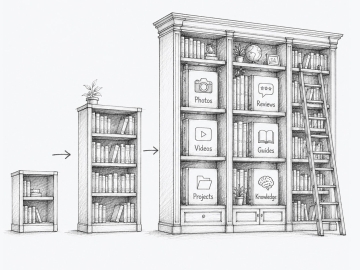
Rather than being the container in which a company's digital value is created and stored, it becomes one distribution layer for a larger collection of business assets.
Consider a completed residential installation. The project has a location, date, application and perhaps a specific turf product. It generates photographs and video. It may produce a customer review. The installer gains additional knowledge about the site, installation conditions and product performance.
These are not independent pieces of content created for a website. They are related outputs of actual business activity.
When those relationships are preserved, the same underlying information can support many different representations. A project can strengthen a project gallery, a residential application page, a local market page, product information and future search or AI discovery without pretending that the asset originated independently in each place.
A city page built from this kind of information can become progressively stronger as the company completes more work in that geography. Its development reflects the development of the actual market.
That is very different from publishing the completed page first and waiting for the market to catch up.
Search and AI Have to Resolve the Same Relationships
The distinction matters increasingly as discovery moves beyond conventional search results.
Search engines and AI systems must determine what a company actually does, where it operates, what it is known for and what evidence supports those conclusions. They must distinguish between a business that mentions a location and one with substantial activity associated with it, or between a company that publishes a page about an application and one whose accumulated digital history demonstrates expertise in that application.
More pages provide more material for these systems to process, but volume alone does not necessarily improve the clarity of the underlying business representation.
The relationships between companies, markets, locations, products, projects, customers and digital assets may therefore become increasingly important. A website architecture that exposes those relationships provides something fundamentally different from one that simply creates more variations of the same page.
Publishing Is No Longer the Scarce Resource
The economics of website publishing have changed dramatically.
Templates can create hundreds of pages from structured data. AI can produce geographic variations of copy almost instantly. Metadata, FAQs and supporting text can be generated at negligible marginal cost. Programmatic SEO can be extremely useful when a business genuinely has enough structured information to support pages at scale.
The scarce resource is no longer the page.
It is the evidence behind the page.
Completed projects remain expensive. Customer relationships take time. Original photography requires actual work to photograph. Geographic experience develops through operations. Product expertise accumulates through repeated use. Reputation cannot be generated from a template.
This changes what businesses should protect and invest in.
The long-term asset is not simply the collection of URLs currently indexed by Google. It is the growing body of business evidence capable of supporting those URLs - and whatever forms of digital discovery replace them in the future.
What Should Actually Be Rebuilt?
After a major rebuild launches, there is inevitably a period of waiting. Redirects settle, pages are crawled and indexed, rankings fluctuate, and the business waits to see whether the investment produces the growth that justified it.
If that growth does not appear, another website change may eventually seem like the obvious response.
Before beginning that cycle again, it is worth asking a different question.
Was the objective to build a better website, or was the objective to enter markets where the business previously lacked sufficient presence?
Those are not the same project.
A website can and should make a company's markets, expertise and geographic coverage clear. But it should not have to manufacture those things from page templates. Every completed project should add to the company's digital history. Every photograph should become a reusable asset connected to the work that produced it. Customer evidence, geographic experience, product knowledge and market activity should accumulate rather than disappear or become disconnected during the next redesign.
When that underlying system exists, a website rebuild becomes what it should have been all along: a new interface for assets the business already owns and continues to develop.
A competitor can reproduce the interface. It can study the navigation, copy the page types and build an equivalent geographic footprint.
What it cannot reproduce is the accumulated business history behind them - or the system that turned that history into a connected business graph.
A competitor can copy the website. It cannot copy the digital entity that made the website valuable.
Related Insights
Explore more analysis on market expansion, digital strategy, website architecture, and the systems that shape long-term demand in the synthetic turf industry.





Build the Markets You Want to Grow
A larger website alone does not create market presence. Explore solutions that connect your existing projects, business knowledge, digital assets, and local presence to the geographic and industry markets where you want to build demand.