How Demand Works in the Synthetic Turf Industry
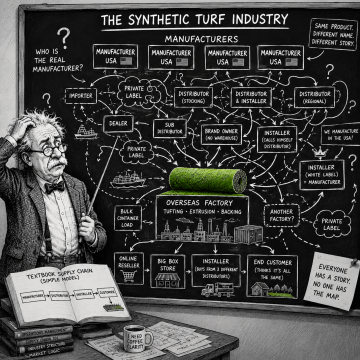
Synthetic turf demand rarely moves through a simple manufacturer - distributor - installer - customer chain. Products are manufactured for multiple brands, distributors may operate as manufacturers or private-label suppliers, installers may buy from several sources, and the same companies can participate in different parts of the market at the same time. Meanwhile, the customer who ultimately creates the project may know almost nothing about the supply chain behind it. Understanding how demand and market information move through this structure helps explain who creates demand, who captures it, where market knowledge accumulates, and why sales at one level of the industry do not always reveal what is happening in the market itself.
Quick Navigation
One Industry, Several Markets
A synthetic turf manufacturer, distributor, and installer may all sell turf, but they are not selling to the same market. A manufacturer's customer may be a distributor placing recurring inventory orders. A distributor's customer may be an installer buying material for multiple projects. The installer's customer is the property owner or organization paying for the finished installation.
The basic commercial chain looks simple:
Manufacturer → Distributor → Installer → Project Customer
But demand moves through that chain in the opposite direction. End customers create the projects that cause installers to need material; installer purchases cause distributors to replenish inventory; distributor orders create demand for manufacturing.
Project demand → Installer demand → Distribution demand → Manufacturing demand
That distinction remains even when several functions belong to the same company. A vertically integrated turf company may manufacture and distribute its own products, sell directly to installers, and operate additional sales channels. It still has separate manufacturing and distribution functions, serving different purposes within the same demand chain.
Manufacturing creates product capability. It determines what can be produced, at what specification, quality, capacity, cost, and consistency. Product development can also create new capabilities or remove technical barriers that previously limited where synthetic turf could be used.
Distribution turns that capability into a commercial business. It decides what products its markets need, carries inventory, establishes commercial price levels, develops sales channels, reaches buyers, supports dealers and installers, and assumes the risk of moving that product.
The distinction is easiest to see when the companies are unrelated. A distributor identifies a product it believes it can sell and contracts a factory to manufacture it. The factory is responsible for producing what was agreed upon. Selling it is the distributor's problem.
Vertical integration changes who owns the factory. It doesn't change the functions or make the commercial problem disappear.
A manufacturer can also advertise, build a brand, support dealers, generate leads, or participate directly in market development. But when it does, it is taking on additional distribution or go-to-market functions; those activities aren't inherent to manufacturing.
And the relationship isn't supposed to run in only one direction. Product moves from manufacturing toward the market, while information about what the market actually needs has to travel back toward manufacturing.
Installers are closest to finished projects, which makes their feedback one of the most valuable sources of market intelligence in the entire chain. They hear why customers hesitate, which alternatives they're considering, what applications they're asking for, which products are difficult to install, which features matter in the field, what problems appear after installation, and which requests existing products cannot satisfy.
But an individual installer's experience is still only one view of the market. Distribution is where those individual signals can become patterns. One installer asking for a different backing may be a preference. Twenty installers reporting the same problem across several markets may be evidence of an unmet product need. Repeated questions about heat, drainage, odor, recyclability, fire ratings, colors, roll sizes, or another application can reveal opportunities that aren't visible from manufacturing alone.
That is the information manufacturing needs upstream. Not simply "we need a new product," but evidence of what the market is asking for, what is preventing sales, how often the problem occurs, and whether solving it could open or protect a meaningful market.
Distribution sits in the middle of both flows. It doesn't just move product toward the market; it can aggregate what the market is saying and send that intelligence back toward the people who can change the product.
That also means some of the industry's richest accumulated market intelligence should sit with distributors. A manufacturer may see product orders and production requirements. An individual installer may know its own customers and projects exceptionally well. A distributor working with hundreds or thousands of installers can potentially see across all of them - which applications are growing, which objections recur, what customers are asking for, where projects are being lost, which products are gaining traction, and how those patterns differ from one market to another.
But having access to that intelligence is not the same as capturing it.
If installer feedback remains in phone calls, project photographs remain on individual phones and social accounts, customer questions disappear after they are answered, and completed installations are never connected back to products, applications, and markets, the distributor may process thousands of transactions without building much market knowledge from them.
The same is true of the digital assets those projects produce. Every installation can generate photographs, videos, reviews, application knowledge, technical solutions, customer questions, and evidence of how a product performs in a real environment. When those assets are collected and connected, they can reveal what is happening across markets and become inputs for future demand. When they aren't, much of what the distribution network learns disappears after the sale.
This makes the distribution layer more than a point between manufacturing and installation. It is potentially the industry's largest collection point for market intelligence and market evidence.
How effectively that collection point works, however, depends heavily on the structure of the distribution network itself.
Dealer Networks and Franchise Systems
How much market intelligence a distribution network can accumulate depends partly on how that network is structured.
In a traditional independent dealer model, the distributor and installer are separate businesses with separate interests. The distributor supplies products, pricing, samples, training, technical support, and sales relationships. The installer develops its own customers, completes projects, builds its local reputation, and owns much of the knowledge and evidence generated through that work.
Information has always traveled between them, but historically much of it traveled through people. A sales representative heard that installers were struggling with a product. A dealer mentioned that customers kept requesting a particular color or application. A distributor noticed that one product was moving faster than another. Trade shows, training sessions, phone calls, account relationships, and sales activity provided information about what was happening in the market.
For much of the industry's history, that could be enough. At its core, the distributor needed a network capable of moving product through independent businesses.
A franchise system was structured differently long before digital market intelligence became important. A franchisor was not simply supplying a product to an independent dealer; it was replicating a business system under a shared brand. That required common standards, training, operating procedures, marketing methods, quality control, territory management, and continuing communication between the central organization and local operators.
Franchising was not created to collect digital market intelligence. But it was built around a tighter connection between the central organization and the businesses operating in local markets.
The internet made that structural difference much more valuable.
Websites could connect customers to individual territories. Leads could be routed to local operators and their outcomes recorded. Reviews could be associated with locations. Finished projects could produce photographs, videos, case studies, application evidence, and performance information. Search and analytics could reveal differences between geographic markets. Customer questions, objections, and project types could be compared across locations rather than remaining inside individual conversations.
The internet didn't create the franchise system's information advantage. It made that advantage far more valuable.
Independent dealer networks can build many of the same capabilities, but the relationship does not provide them automatically. The installer owns its customers, projects, reviews, photographs, website, reputation, and local market position. It has no inherent reason to give a supplier every project asset, customer question, lost-sale explanation, or piece of market knowledge it produces.
The distributor has competing incentives as well. It benefits when installers become stronger customers, but successful independent installers can change suppliers, negotiate directly with manufacturers, begin importing, or become distributors themselves. The relationship therefore contains limits on how much either side may want to invest in strengthening the other's market position.
This can leave a large dealer network commercially connected but informationally fragmented. Thousands of projects may use products supplied by the same distributor without the distributor developing a reliable record of where those products were installed, why customers chose them, which alternatives they considered, what objections occurred, or what evidence the completed projects produced.
Digital technology makes that lost information more consequential than it once was. Without systems for collecting and organizing market activity, a modern dealer network can still operate much like an older one. Product leaves the warehouse, salespeople manage accounts, installers complete projects, and most of the knowledge surrounding those projects remains distributed among individual companies, employees, emails, social accounts, and conversations. The distributor records the transaction but retains relatively little structured information about why the project existed, what the customer needed, or what the market learned from it.
A connected franchise network has a structural advantage here because the relationship between the central organization and local operators is already part of the business system. Project information, product usage, marketing activity, lead outcomes, reviews, local performance, and other market evidence can be collected through common processes and platforms. A project completed in one territory can therefore contribute knowledge that is useful beyond that territory.
The advantage is not simply having more locations. It is the ability to observe many local markets through the same system.
That connection can strengthen market development downstream by allowing brand visibility, local presence, project evidence, territories, and lead activity to operate as parts of the same system. It can also improve the information moving upstream. When similar customer objections, product limitations, or application requests appear across multiple markets, the organization can distinguish an isolated observation from a broader pattern and provide manufacturers with better evidence of what the market may need next.
Independent distribution networks are not inherently excluded from this advantage. They can build systems that preserve installer independence while creating clear incentives and permissions for useful information and project evidence to move through the network. But those connections have to be deliberately designed; the commercial relationship alone does not create them.
This is why the difference between having a large network and having a connected system is becoming more important. A distributor may have thousands of installer accounts and enormous physical market reach while retaining relatively little knowledge about the markets those installers serve. A smaller but more connected network may have a clearer view of which applications are growing, why customers are buying, what prevents projects from proceeding, and how those conditions are changing.
The systems that can see their markets, retain what those markets produce, and act on what they learn are increasingly the systems best positioned to shape what happens next.
Market Knowledge Has to Become a Market Asset
Providing better feedback to manufacturers is one use of the information accumulated across a distribution network. The larger use is market development.
Every completed project produces information beyond the sale itself. Installers encounter customer questions, objections, alternative solutions, site conditions, application requirements, product limitations, and installation problems. Finished projects add photographs, videos, reviews, performance evidence, and examples of how products are being used in actual markets.
Across a large distribution network, these observations can provide a much broader view than any individual installer has. But that advantage exists only if the information is collected and retained. If project evidence remains on installers' phones, customer questions disappear after sales conversations, and application knowledge remains with individual employees, the distributor has access to the market without accumulating much knowledge from it.
A digital system makes that knowledge reusable. Projects can be connected to products, applications, installers, locations, customer questions, technical information, and market outcomes. Some of that information remains internal for analysis. Other parts can be developed into public resources: project evidence, application guidance, technical answers, comparisons, case studies, and other information useful to future buyers.
This is one way market authority develops. It is not simply a function of publishing more content. Authority becomes stronger when a company can demonstrate sustained experience with a market through real projects, useful knowledge, technical evidence, and answers to the questions customers actually ask.
Historical accumulation is important because market intelligence also has a time dimension. A distributor may see occasional requests for an application for years before those requests begin increasing. Customer objections may change. Certain products may become more important in particular regions. New applications may appear first as isolated projects and later as recognizable patterns.
Without retained historical information, each observation is largely independent. With it, the company can evaluate changes in market intent and distinguish an isolated request from a developing market.
That can influence where the company invests next. Existing project evidence and application knowledge can be used to strengthen market presence where demand is already developing, or to enter another geographic or application market with more evidence than a company starting from zero.
For this reason, ownership of digital assets becomes part of the business infrastructure. Project records, product data, photographs and usage rights, application knowledge, customer questions, technical answers, analytics, and the relationships among them represent accumulated market experience. If those assets remain scattered across social platforms, employee accounts, installers' devices, agencies, and disconnected software, much of that experience cannot be analyzed or reused reliably.
AI increases the value of having this information structured and retained. It can help identify recurring questions, compare feedback across markets, detect changes over time, organize project knowledge, and make accumulated information easier to use. But it cannot analyze information that was never collected or reliably reconstruct relationships that were never recorded.
The important difference, therefore, is not simply how much information a distribution network produces. Large networks have always produced enormous amounts of it.
The difference is how much of that market experience the organization retains, connects, and can use to develop the next market.
Demand Depends on What the System Retains
The synthetic turf industry does not operate as one market. Manufacturers, distributors, installers, dealers, and franchise systems perform different functions and often serve different customers, even when several of those functions exist inside the same company.
What connects them is the movement of product, demand, and information.
Products move downstream from manufacturing toward finished projects. Market signals move in the opposite direction: customers and projects teach installers, installers provide feedback to distribution, and distribution can aggregate those observations into intelligence useful to manufacturers and the broader business.
The same projects also produce evidence that can support future demand. Customer questions, applications, photographs, reviews, technical solutions, and project outcomes can remain isolated at the point where they were created, or they can become part of the accumulated knowledge of the network.
That distinction matters more as the industry becomes increasingly digital. A large dealer network, a national footprint, or decades of transactions do not automatically produce strong market intelligence or market authority. Those advantages depend on whether the business has systems capable of retaining what its markets produce, identifying changes over time, and turning useful knowledge into assets that can support existing and new markets.
Franchise systems have a structural advantage because shared brands and operating systems make these connections easier to establish. Independent distribution networks can build the same capability, but the exchange has to be designed deliberately around businesses that retain their own customers, brands, and assets.
The result is not a system in which every participant becomes responsible for everyone else's marketing. The functions remain distinct. Manufacturing needs reliable information about what markets require. Distribution needs to understand and develop the markets through which its products move. Independent installers need to build and protect their own local demand while contributing useful market feedback to the channel.
The competitive difference increasingly lies in how well those functions remain connected.
The turf companies and networks best positioned for future growth will not necessarily be those with the most products, dealers, or locations, but those that can learn from the markets they already serve and use that knowledge to develop the markets they want to serve next.
Explore the Demand System
Understand the larger system behind installer growth — how synthetic turf demand develops, how markets are created, and how digital infrastructure, market presence, and authority work together to support future demand.