Why Information Needs a Home
August 1, 2026
Growing businesses do not struggle to create information. They struggle to manage it.
Every project completed, review earned, photo captured, and customer question answered creates information. As businesses grow, that information begins accumulating across websites, social media platforms, emails, documents, and employee devices. The challenge is not producing more content. The challenge is ensuring important information has a permanent home and remains accessible, accurate, and useful over time.
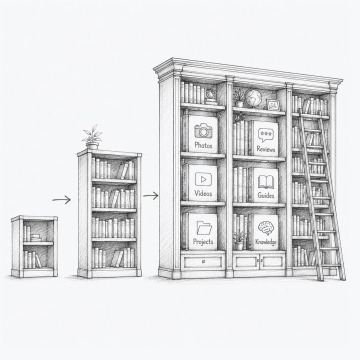
Growing businesses do not struggle to create information. They struggle to manage it.
Every completed project creates photos, videos, documents, customer feedback, and new knowledge. Every customer interaction generates questions, answers, estimates, emails, and records. Over time, businesses accumulate a growing collection of information that supports operations, sales, marketing, customer service, and decision-making.
The challenge is not creating this information.
The challenge is ensuring it remains organized, accessible, accurate, and useful over time.
Most businesses do not think about this when they are getting started. Project photos are uploaded to social media. Reviews are collected on third-party platforms. Product information is stored in brochures. Team photos remain on employee devices. Service descriptions are copied from one platform to another whenever they are needed.
For a while, this works.
Then the business grows.
More projects are completed. More employees join the company. More services are added. More customer questions need to be answered. Information begins accumulating across websites, social media platforms, cloud drives, email accounts, marketing materials, and employee devices.
At some point, the business stops struggling to create information and starts struggling to manage it.
Growth Creates Complexity
As organizations grow, information naturally becomes distributed across multiple systems.
Customers may discover the business through Google. Employees may rely on internal documents. Sales teams may use project photos and case studies. Marketing teams may publish content across multiple channels.
The challenge emerges when information changes.
Service areas expand. Product offerings evolve. Contact information changes. New locations open. Team members come and go.
Information that once existed in a single place now needs to be updated across websites, business profiles, social platforms, marketing materials, and internal systems.
What begins as a simple update can quickly become a time-consuming process.
Over time, different platforms often contain different versions of the same information. An outdated phone number may remain on a directory listing. A discontinued service may still appear on an old page. A project photo may exist on social media but nowhere else.
Individually, these issues seem minor.
Collectively, they create confusion for customers, inefficiencies for employees, and additional work for the organization.
The Cost of Fragmented Information
Fragmented information rarely becomes a problem overnight.
Instead, small issues accumulate over time.
Employees spend time searching for information that already exists. Customers encounter inconsistent information across different platforms. Marketing materials become outdated. Valuable project history becomes difficult to locate and reuse.
The challenge becomes even greater when employees leave, platforms change, or access to accounts is lost.
Information that should belong to the business may be tied to personal devices, inactive email accounts, or third-party platforms. In some cases, years of project photos, documentation, and customer knowledge become difficult to recover.
By the time these problems become visible, organizations may already be managing hundreds or thousands of information assets spread across dozens of locations.
Establishing a Source of Truth
Successful organizations eventually solve this problem by creating a central source of truth.
A source of truth is the place where important business information originates, is maintained, and remains under the company's control.
When information changes, it is updated there first. Other systems and platforms can then be updated from that source.
The goal is not to eliminate every platform or tool. Businesses still rely on social media, email, business directories, marketing materials, and cloud storage systems.
The goal is consistency.
A source of truth helps ensure employees, customers, partners, and vendors are working from the same information.
Why Websites Often Become the Source of Truth - And Why Many Don't
For many businesses, the website has the potential to become the central source of truth.
Unlike third-party platforms, the business controls its content, organization, and long-term ownership. Customers can access it directly, search engines can index it, and AI systems can understand and reference the information it contains.
However, simply having a website does not automatically make it the source of truth.
Many business websites are little more than online brochures. They contain a handful of pages with basic company information but provide no practical way to organize projects, products, documents, knowledge, photos, videos, or other digital assets as the business grows.
As a result, important business information often becomes scattered across shared drives, cloud storage, social media, employee computers, emails, and third-party platforms.
The website becomes just another place where information appears - not the place where it is managed.
A website can only become a true source of truth when it is supported by a system that allows business information to be organized, maintained, and expanded over time.
Only then can it consistently distribute accurate information to customers, employees, search engines, AI systems, and other digital channels.
The goal isn't simply to own a website.
The goal is to establish a trusted source of business information and use the website as one of the primary ways to publish it.
Information as a Business Asset
As businesses mature, they often begin viewing information differently.
Every completed project, customer review, article, photo, video, process document, and service page contributes to the knowledge and reputation of the organization.
These assets help answer customer questions, support sales conversations, train employees, improve visibility, and build trust.
Like equipment, vehicles, facilities, and customer relationships, information becomes more valuable when it is organized, maintained, protected, and accessible.
The value of information is becoming even more apparent as digital discovery continues to evolve.
Twenty years ago, businesses primarily documented information for internal use. Later, they documented information for customers and search engines. Today, that same information is increasingly consumed by AI systems, recommendation engines, and automated discovery platforms.
Information that helps a customer today may support a sales conversation tomorrow, train an employee next year, or influence an AI-generated recommendation years from now.
Organizations that maintain structured, accessible information are not simply preserving knowledge. They are building long-term business assets.
Think Beyond Today
Many businesses focus on creating more content. They want more project photos, more videos, more reviews, and more social media posts.
Those assets are valuable.
But as organizations grow, another question becomes increasingly important:
Where will all of that information live five years from now?
The businesses that scale successfully are often the ones that think beyond the next post, the next project, or the next marketing campaign. They create systems that preserve knowledge, organize assets, and make information accessible long after it is created.
Information does not become valuable only when it is published. Its value often grows over time.
A project gallery may help earn trust years after the project is completed. A service page may answer thousands of customer questions throughout its lifetime. A documented process may help train future employees. A customer review may continue influencing buying decisions long after the original project is finished.
Growing businesses understand that information is not disposable.
It is an asset.
And like any asset, it becomes more valuable when it is protected, maintained, and allowed to compound over time.
This is where a Digital Entity Foundation becomes essential.
Rather than treating projects, photos, documents, products, and knowledge as isolated pieces of content, a Digital Entity Foundation organizes them into a structured business asset that can power your website, AI search, customer portals, future markets, and whatever digital platforms come next.
Technology will continue to change.
Well-organized business information will continue to create value.